Charleston created the first preservation ordinance in the United States in 1931, and its Board of Architectural Review has been reviewing exterior changes ever since. Yet the city keeps no list of approved paint colors.
Inside the city’s historic districts, repainting a building you can see from the street needs a BAR application, even in the same color, and a new color also needs the city’s color form.
Most color changes are approved by preservation staff, not the full board. Painting brick, stone or stucco that has never been painted goes to the board, and so does any change to a building rated Category 1 or 2.
The steps below follow the city’s own documents: the BAR overview page, the color change form, the policy statement on staff reviews (amended January 2024) and the BAR General Guidelines booklet (March 2024).
Step 1: Find out whether the BAR covers your address
Whether the board has a say depends on the district, the age and rating of the building, and whether the work can be seen from a public street.
The guidelines booklet answers it with a chart, “Does my project need BAR approval?” For exterior repairs and alterations, which is where repainting falls, it reads:
| Area | Is exterior work reviewed? |
|---|---|
| Old and Historic District | Yes, if visible from a public right-of-way |
| Old City District | Only if the building is at least 100 years old, rated, or previously reviewed by the BAR, and visible from a public right-of-way |
| Historic Corridor District | Only for commercial buildings and multifamily properties of eight or more units, when visible from a public right-of-way |
| Landmark Overlay properties | Yes, whether visible or not |
Check the address on the city’s BAR boundaries map. Staff makes the final call on purview and on what counts as visible, so when the answer is close, ask before you buy paint.
Step 2: Check how the building is rated
The city surveyed buildings in the Old and Historic District and the Old City District in its architectural inventories of 1974 and 1986, rating them from Category 1, the most exceptional, to Category 4, contributing buildings.
The guidelines booklet is direct about the top two: Category 1 and 2 buildings go before the board for any alteration, and it names paint color changes in that list.
The inventory cards are public and kept at the Permit Center on George Street. If your house has a rating, find it out first; it decides whether you are waiting for a staff signature or a board meeting.
Step 3: Same color or a new one?
On paper, the difference is one form. A new color needs the color form plus a completed BAR application. Repainting in the existing color needs only the application.
The form asks for the color, manufacturer and code for each part of the building: the main body, exterior doors, roof, foundation, trim, window sash, shutters, piazza or porch columns and balustrade, piazza deck, piazza ceiling, and walls or fences. Two more rules sit at the bottom of the form:
- custom colors must come with physical swatches;
- any repair or replacement of elements that will be painted, such as rotten trim, has to be written into the scope of work on the application, and photos may be requested.
Our checklist on how to choose exterior paint colors builds the same part-by-part list from the start, so the form becomes a copy job.
Step 4: Is any of the masonry unpainted?
This is the branch that changes the timeline most. The color form states that painting unpainted masonry, meaning brick, stone or stucco, requires board-level approval, and the staff policy repeats it.
On substance, the guidelines go further. In general brick should not be painted unless it was painted before, because paint can trap moisture in a historic wall.
Historic unpainted stucco and brick should stay unpainted, and elastomeric or “waterproof” paints are not permitted on historic masonry. If your plan includes a brick foundation that has never seen paint, expect a board hearing, with the guidelines leaning against it.
Step 5: Pick colors staff can say yes to
There is no palette to choose from. The guidelines booklet says color approval is given case by case, based on the style of the architecture, the character of the adjacent buildings and the neighborhood, and that garish colors in general are to be avoided.
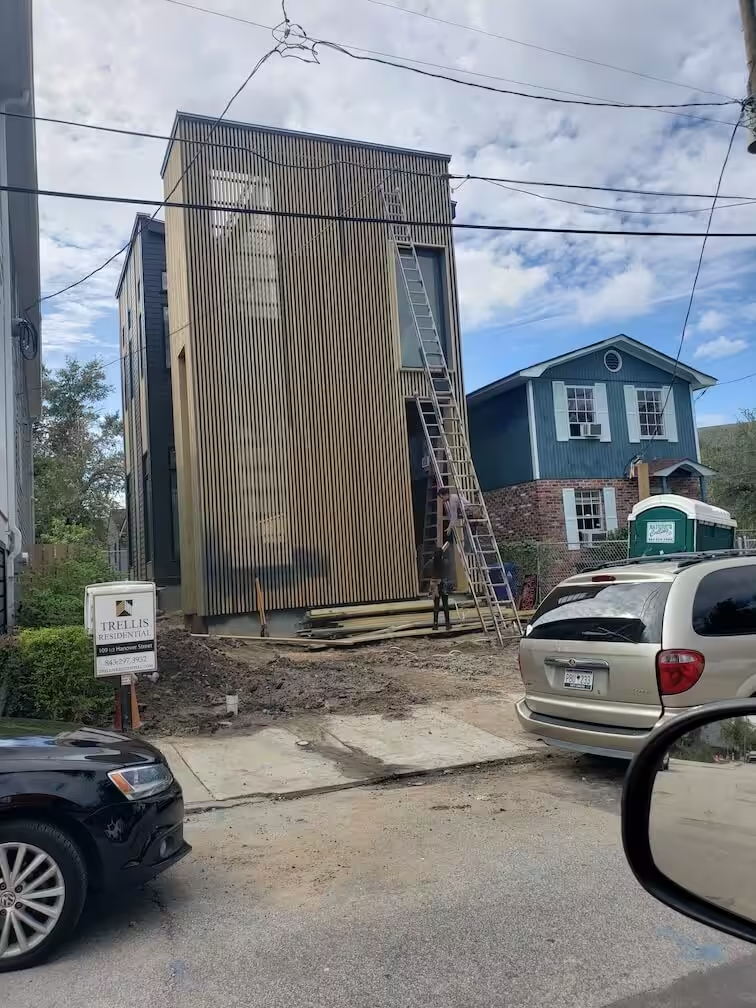
Context is the test. This modern townhouse on a downtown street, shown before we painted its siding charcoal, stands a few feet from an older blue house. A color that suits one building can read very differently next to its neighbors.
The booklet points owners to the Historic Charleston Foundation’s colorsheet as a reference for colors commonly found in the city, and states plainly that it is not a pre-approved list.
Staff may also ask for a test patch on the building before deciding, according to the staff policy. Plan the samples into your schedule rather than treating them as a surprise.
For the city’s most photographed palette, see our piece on Rainbow Row colors.
A real case: 126 Coming Street, January 2026
The BAR-Large meeting results of January 14, 2026 show what top-rated buildings go through. The application for 126 Coming Street, a Category 1 building from about 1816 in the Old and Historic District, asked for final approval of exterior color changes and stucco work.
Staff noted that a Category 1 building needs board review, and supported the color selections on the basis of the applicant’s stucco and paint analysis, which included micrographic studies of the original stucco and paint. The board approved it 4 to 0, with one member recused.
The lesson for owners of rated buildings: the strongest color proposal is one tied to evidence of what the building actually wore.
Step 6: Submit, wait, and watch the calendar
Staff decisions are posted weekly on the city’s site and can be appealed within 15 calendar days. Work that needs the board waits for a meeting: the BAR-Small meets on the second and fourth Thursdays of the month and the BAR-Large on the second Wednesday.
Agendas are capped at 15 items for BAR-Small and 8 for BAR-Large, and they fill. In July 2026 the city posted that the July 9 BAR-Small agenda was already full and pointed applicants to the next meeting. The city also charges a review fee for color changes, listed on its fee schedule.
BAR approval is not the only stamp. The guidelines say Zoning and Building Inspections reviews also apply, and the city’s process chart ends with collecting the BAR placard after permitting. If you also live under an HOA, its approval is separate; our guide to HOA painting approvals covers that side.
Step 7: Know the prep rules before work starts
Approval covers how the paint comes off, too. The guidelines booklet sets these limits for paint removal on historic buildings:
- disc sanding, sandblasting and open flame are never permitted;
- mechanical sanders only on flat boards, never on details;
- highly acidic paint removers are not permitted;
- homes built before 1978 likely have lead-based paint, and owners are told to contact Building Inspections about lead hazards before work begins.
Any estimate for a house in the districts should describe a prep method that fits inside those lines.
Call preservation staff first, then the painter
The shortest path is a phone call before you buy a single sample. The Preservation Division’s number in the guidelines booklet is 843-724-3765, and staff can tell you the district, the rating and whether your plan is a staff review or a board item. Fill in the BAR color change form once you know.
VMS Home Painting provides exterior painting for historic Charleston homes as well as newer ones. Share your address and the colors on your form, and request a free exterior estimate written around the approval you have or are waiting for.