Rainbow Row is the run of 13 historic houses at 79 to 107 East Bay Street in Charleston, on the west side of the street between Tradd and Elliott. Its colors matter beyond the postcards: it is the palette people bring to a painter when they say they want “something Charleston.”
The Rainbow Row colors are soft pastels, one per house, in the pinks, yellows, blues, greens and lavenders that local histories describe, each set off by its own trim, shutters and doors.
There is no official list of paint codes. Each owner chooses and repaints, so the row you see this year may not match an older photo.
Rainbow Row at a glance
- Where: 79 to 107 East Bay Street, west side, between Tradd and Elliott streets.
- How many: 13 buildings, most of them sharing party walls with their neighbors.
- Built as: merchants’ buildings with a store on the ground floor and living space above, facing what was once the Cooper River waterfront.
- Which way they face: east, toward the harbor, so the facades get the morning sun.
- First pastel: 99 to 101 East Bay, painted pink in 1931.
How the row got its colors
After the Civil War the buildings fell into disrepair. In the 1920s, Susan Pringle Frost, who formed what became the Preservation Society of Charleston, bought six of them to save them.
According to the SC Picture Project, the color story starts in 1931, when Judge Lionel Legge and Dorothy Porcher Legge bought 99 to 101 East Bay and painted it a pastel pink; neighboring owners followed, and the “rainbow” took shape.
The tale about sailors needing bright colors to find their way home is just that. The restorers of the 1930s and 1940s chose the hues; Dorothy Legge’s pink is usually traced to a colonial Caribbean color scheme.
The same year, 1931, the City of Charleston created what its own Board of Architectural Review page calls the first preservation ordinance in the United States, along with the board itself.
The colors on record
Few sources name a color house by house, and the ones that do describe what was on the walls when they were written. Three are well documented:
- 99 to 101 East Bay: pastel pink, the color that started the row in 1931.
- 93 East Bay, the James Cook House: bright yellow in the Old Town Trolley Tours guide, and the bright yellow house in the panoramic photo on the row’s Wikipedia entry.
- 95 East Bay: described by the same trolley guide as a four-story pastel green house.
The rest fill in the pinks, blues, greens and lavenders that tour histories list. The SC Picture Project captions a painting of the row with a reminder that colors change as new generations of owners repaint.
Is there an official Rainbow Row paint list?
No. You will find palettes online labeled “Rainbow Row,” including one published by a homeowners association in Florida with its own paint codes, but those are someone’s interpretation, not the colors on East Bay Street. Matching from a photo is unreliable too: screens, cameras and the time of day all shift a color.
The workable route is to pick a family (a warm pink, a buttery yellow, a soft green) and choose the exact color from paint store samples held against your own house, in your own light.
A painter’s glossary of the row
A palette on a historic facade is never one color. The house-by-house facts below come from the row’s Wikipedia entry, which cites Jonathan Poston’s The Buildings of Charleston and Charleston newspaper files. The last line of each term is where it lands on the City of Charleston’s color change form.
Body color
The main wall color, the one people mean when they say “the pink house.” On Rainbow Row it is the pastel. On the form, it is “main body of building.”
Trim
Cornices, window and door casings, corner boards. Lighter trim keeps a pastel crisp; trim close to the body color makes the facade read as one block. On the form: “trim.”
Window sash
The frames that hold the glass, separate from the casing around them. 87 East Bay still has its original windows. On the form, sash has its own line.
Shutters and doors
Often the darkest notes on a facade, and the parts that change the mood of a pastel the most. The form lists shutters and exterior doors separately, with manufacturer and code for each.
Balconies and piazzas
Several houses on the row gained balconies during restoration: Susan Pringle Frost added one to 87 and a neoclassical balcony to 83. On a Charleston single house, the piazza gets three lines on the form: columns and balustrade, deck, and ceiling.
Storefronts
The row was built for commerce. 105 East Bay, the Dutarque-Guida House, is the only building on Rainbow Row that kept its iron Victorian storefront, with the Guida name on it. Painted metal storefronts and their trim are part of the color plan, under “other” on the form.
Stucco and brick
87 East Bay keeps its original stucco along with its windows. Masonry has its own rule in the city’s review districts: the form says painting brick, stone or stucco that was never painted needs Board-level approval.
Party walls
Most of the row’s buildings share side walls, and 97 and 99 to 101 even share a roof and decorative details. Where two colors meet at a shared wall, the line between them is part of the design: neighbors in contrasting families keep each facade distinct.
Why pastels suit an east-facing street in the Lowcountry
Morning light is the row’s light. Sherwin-Williams’ article on light and color explains that morning sun is lower and warmer, with a yellowish cast, while midday light turns cooler and bluer. That warm early light flatters pinks and yellows on an east-facing facade.
There is a practical side too. Lighter tints reflect more light, and the Heat Island Group at Lawrence Berkeley National Laboratory describes how walls that strongly reflect sunlight stay cooler in the sun, while dark walls can heat a building. The tour guides’ line about pastels keeping houses cooler has physics behind it.
Your own Rainbow Row palette, on paper
Print this and fill one line per part of your house. The parts follow the City of Charleston’s color change form, which asks for the manufacturer and code of each color and a physical swatch for any custom color.
- Main body: color ______ maker ______ code ______ sheen ______
- Trim: color ______ maker ______ code ______ sheen ______
- Window sash: color ______ maker ______ code ______
- Shutters: color ______ maker ______ code ______
- Exterior doors: color ______ maker ______ code ______
- Piazza or porch columns and balustrade: color ______ code ______
- Piazza deck: color ______ code ______
- Piazza ceiling: color ______ code ______
- Foundation: color ______ code ______
- Walls and fences: color ______ code ______
- Test plan: two large samples per finalist, viewed at 9 a.m., noon and late afternoon.
- Neighbors: colors of the houses on each side, so yours doesn’t repeat or clash.
Inside the review districts, most repainting goes through staff review, and if the new color matches the existing one, the form says only the BAR application is needed. The Board of Architectural Review page explains how to apply.
Samples, sheen and the order of decisions are laid out in our guide on how to choose exterior paint colors. If your house is closer to the beach than to East Bay, our guide to pastel and coastal palettes on Lowcountry houses shows how soft greens and yellows work on raised homes.
Not every house on the peninsula goes pastel
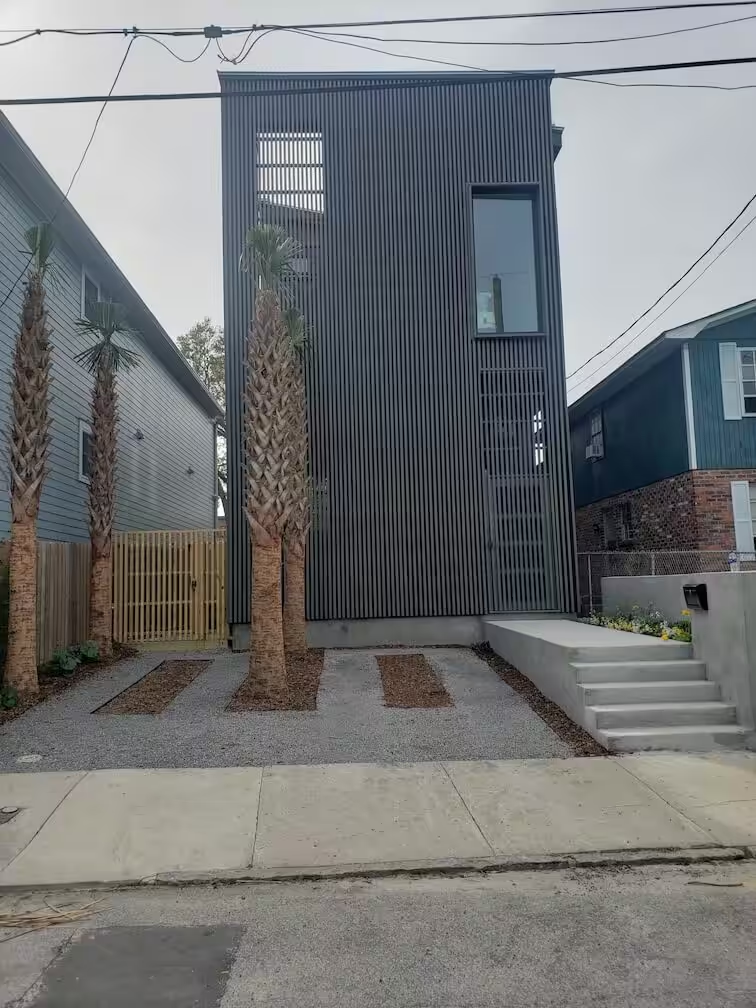
A few blocks from the postcard views, one of our projects went the other way: a three-story Downtown Charleston townhouse with vertical siding painted a bold charcoal gray, next door to a blue house with white trim. Charleston’s color tradition is a habit of choosing deliberately, part by part, more than a single palette.
Whether your plan is pink with white trim or charcoal with black, bring the filled-in worksheet. VMS Home Painting handles exterior house painting in Charleston on the peninsula and beyond; request a free exterior estimate and tell us if your house sits in a review district.