A commercial painting estimate is the painter’s written price for a defined scope: which surfaces, prepared how, coated with what, in what order and under what conditions. The number at the bottom only means something next to that scope.
For an owner or a facility manager, the estimate matters before the price does, because change orders and disputes on a paint job tend to start with something the estimate never mentioned.
Below are the questions people ask about commercial estimates, answered from the owner’s side of the table, with a line-by-line table to read any bid against.
How do painters measure a commercial job?
From the drawings or from a walk of the building, the estimator does a takeoff: every surface listed with its area, height and access. The Painting Contractors Association has a standard for this (P10), and it explains why two bids on the same building can show different square footage.
- Small openings in a wall are ignored and measured as wall. Openings of 100 sq ft or more are deducted, as are floor-to-ceiling openings wider than five feet.
- Anything less than a foot wide, such as a pipe, a rail or a narrow trim board, is counted as one square foot per linear foot.
- Items with the same surface, finish, method and access can be grouped under one production rate; anything different is listed on its own line.
Ask each bidder how the quantities were measured. If one counts by the PCA rules and another by floor area, their “per square foot” figures are not the same unit.
What do commercial painters charge per square foot?
We do not publish rates, and we would be wary of any single number. P10 states that when work is priced by the unit, the request has to describe the surface, the finish, the application method, the access and the minimum quantities, and that items differing in any of those should be priced separately.
Even inside one building, a hallway, the underside of a tall roof deck and a humid pump room each carry their own unit price. A useful estimate breaks those areas out so you can see where the money goes.
What should a complete estimate list?
Read any bid, ours included, against this table.
| Line | What to look for | Why it matters |
|---|---|---|
| Areas and surfaces | Each area named, with walls, ceilings, doors, frames, railings, exterior elevations | “Paint the building” is not a scope |
| Surface preparation | Cleaning method, repairs included, how extra repairs will be priced | Prep decides how long the coating lasts |
| Coating system | Primer, product line, sheen and number of coats per surface | Two coats of one product and one coat of another are different jobs |
| Film thickness | Dry film thickness, when your specification calls for it | On interior work, the PCA’s P13 standard sets how it is inspected when specified |
| Access | Ladders, lifts, scaffolding, and who provides them | Height and equipment drive labor on large buildings |
| Schedule and phasing | Working hours, phases, nights or weekends, the finish date | After-hours work and fixed deadlines change crews and cost |
| Protection | Floors, equipment, furniture, pavement, landscaping, vehicles | Occupied buildings need it every day of the job |
| Exclusions | A written list of what is not included | The industry’s default list is long (next question) |
| Close-out | Punch list process, cleanup, attic stock, warranty | Defines when the job is finished |
| Paperwork | License number, certificate of insurance, documents your owner or general contractor requires | Needed before the first day on site |
What does a commercial painting estimate usually leave out?
Whatever is not written in. The PCA’s standard on typical exclusions (P23) lists items that are not part of the painting contract unless the documents name them. For commercial buildings, the list includes:
- mechanical ducts, pipes, conduit and equipment, and electrical boxes and raceways;
- fire sprinkler piping;
- exposed steel and concrete ceilings;
- acoustical tile and sprayed acoustic ceilings;
- vents, grilles, louvers, speakers and covers;
- concealed spaces, floors, prefinished items and roof-mounted items;
- light poles, benches, signage and planters outside.
If you expect the open-ceiling ductwork in a renovated office to be painted, it has to be on the scope. On our community center gym project, the high ceilings, exposed ductwork and beams were painted from lifts; in a bid, that is its own line.
Does the building have to close?
Usually not, but the estimate has to say how it stays open.
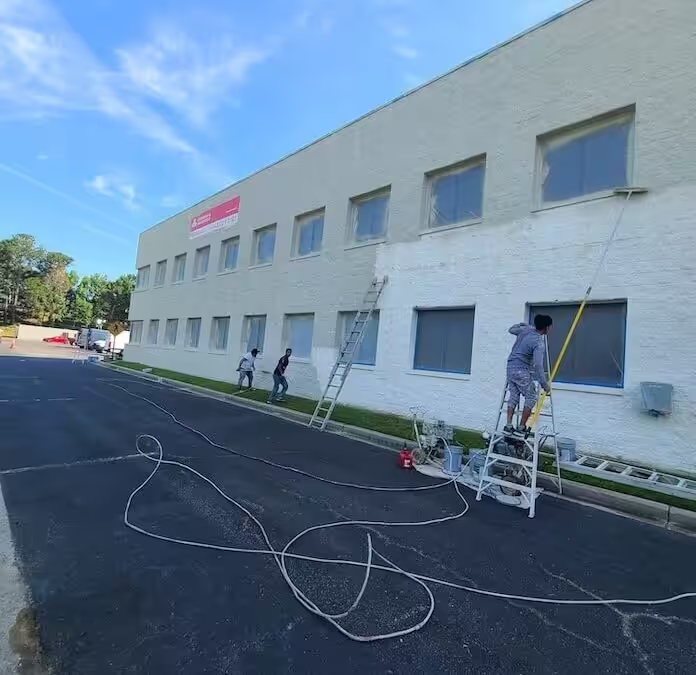
On the 82,320 sq ft commercial building on Eagle Drive, the work covered washing and surface prep on the whole exterior, weather-resistant coatings in light tones and masked-off pavement, with phasing planned to keep access to the property.
At Summerville High School, Phase 3, the interior work was coordinated with the construction schedule so the school could open on time.
Phasing like that belongs in the estimate as dates and hours, not as a promise. For multi-building residential properties, our guide on how to plan an HOA repaint project covers phasing around residents.
What should I send to get an accurate estimate?
- the address, the type of building and how it is used during the day;
- drawings or a specification, if there are any;
- the areas you want painted, and anything you know you do not;
- colors, or who will choose them;
- working-hour limits, access rules and the deadline;
- the paperwork the owner or general contractor requires from subcontractors.
A site walk comes next. An estimate written without one is a guess about prep and access.
License and insurance papers with the bid
Ask every bidder for the license number and a certificate of insurance, and check the license on the SC LLR website before you sign.
Which license a South Carolina painter needs depends on the type and size of the job; our article on whether painters need a license in South Carolina explains the rules, and the paperwork for our commercial painting work in Charleston is listed on that page.
One rule for comparing bids
Give every bidder the same scope, and make them price it the same way. When the areas, the prep, the system and the exclusions match, the numbers can be compared; when they do not, the lowest bid can simply be the one that left the most out.
If you want VMS Home Painting on your bid list, send the address, the type of building and your deadline, and we will schedule a walk-through: ask for a commercial painting walk-through.