What paint should never go on brick? Any coating that seals water inside it. It is the right first question for anyone weighing a painted brick house.
Brick passes moisture vapor in both directions, and the Brick Industry Association warns that a film that blocks it can leave water inside the wall, where it can flake or crack the brick face and feed mildew in the materials behind it.
Painting brick exterior works when the brick is clean, dry and old enough, gets an alkali-resistant masonry primer and a breathable masonry paint, and when you accept that the change is close to permanent.
In Charleston’s historic districts, there is one more condition: painting brick that has never been painted needs the Board of Architectural Review to approve it.
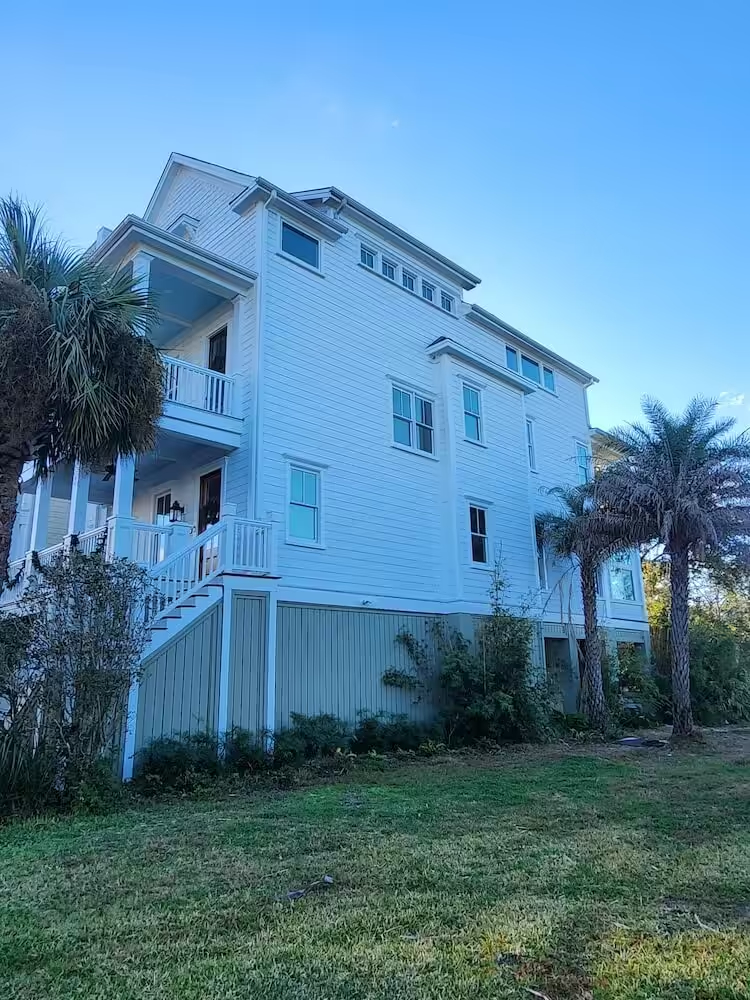
The red brick house in Coosaw Creek
One of the projects published on our site is a traditional brick home in Coosaw Creek, in North Charleston. The project page records what the job involved:
- the whole house taken from red brick to a pale green;
- windows, doors, columns and other trim painted crisp white;
- a detached garage painted to match the house;
- a screened porch with its trim and columns;
- scaffolding for the taller walls, surface preparation for adhesion, and masonry paint made for brick.
That list is a good outline of any brick repaint. The brick is only part of the scope. Trim, outbuildings and porches decide how finished the house looks, and the height of the walls decides how the crew reaches them.
What the page does not say is how many coats went on, which products were used or how long the brick dried before priming. Those are exactly the numbers that decide whether paint on brick lasts, so the rest of this article sets them out from the brick and paint makers’ own documents.
The numbers to check before anyone opens a can
| Check | The number | Source |
|---|---|---|
| New brickwork | Do not paint sooner than 28 days after the brickwork is finished | Brick Industry Association, “The Do’s and Don’ts of Painting Brick” |
| Cure time before the finish paint | About 30 days; if painting cannot wait, 7 days plus a masonry primer | Sherwin-Williams, Emerald Exterior Acrylic data sheet (03/2026) |
| Minimum before a masonry primer | At least 7 days, with mortar cured at 75°F | Sherwin-Williams, Loxon Concrete & Masonry Primer-Sealer data sheet (07/2023) |
| Moisture in the masonry | 15% or lower | Same Loxon data sheet |
| Alkalinity the primer tolerates | pH 6 to 13 | Same Loxon data sheet |
| Breathability of the primer | 25.79 perms (ASTM D1653) | Same Loxon data sheet |
| Wait between primer and topcoat | 24 hours at 77°F and 50% relative humidity (dry to the touch in 4); air and surface must stay above 40°F for 48 hours | Same Loxon data sheet |
| Repaint expectation | “Every three to five years,” as most paint authorities agreed at the time | BIA Technical Note 6 (1972, reissued 1985) |
Two of those rows disagree, and that is useful. The primer maker allows masonry as young as 7 days; the brick association asks for 28. On new brick, the longer wait costs nothing and gives mortar time to cure and early salts time to surface where you can see them.
The last row is old, and coatings have improved since 1972. Treat it as a warning about maintenance, not as a schedule. Paint on brick is a film that ages like any other exterior paint, while bare brick needs almost nothing.
Three questions that come before color
Has this brick ever been painted?
If it has, you are repainting, and the decision is mostly made. If it has not, you are choosing to start a maintenance cycle on a material that did not need one. The BIA calls painting brick a last resort and lists the alternatives below.
Is the house in a historic district?
On the peninsula and in other districts under the City of Charleston’s review, the BAR’s General Guidelines (March 2024) say that brick should not be painted unless it was painted before, because paint can trap moisture in historic brick.
The same guidelines say elastomeric or “waterproof” paints are not permitted. The city’s staff-review policy keeps the painting of previously unpainted masonry at board level. Our article on how BAR paint color approval works covers the application.
Is water already getting in?
White salt deposits, a damp band near the ground, cracked mortar joints or a gutter that overflows onto the wall all mean moisture is moving through the masonry.
BIA Technical Note 6 says paint blistering on brick is caused by water within the masonry, and that the source has to be found and stopped. Paint over that problem and it comes back through the paint.
Prep: where most of the work is
- Clean with the gentlest method that works. BIA Technical Note 20 says to match the method to the brick and to test a sample area of about 20 sq ft, judged only after it dries.
- Keep water pressure low. Where pressure washing is used, the same note caps it at 400 psi, with a 25 to 50 degree fan tip held at least 12 inches from the brick. Our notes on washing before painting explain how it fits into the rest of the prep.
- Remove efflorescence, then wait and look again. Technical Note 6 says to remove it and watch for it to come back before painting. If it returns, there is still water to deal with.
- Repair joints and cracks. Defective mortar gets repointed; small gaps get a masonry patch or sealant. In historic districts, the BAR guidelines ask for mortar that matches the original in strength.
- Let the wall dry. The Loxon limit of 15% moisture is easy to check with a meter, and impossible to judge by touch after a week of Lowcountry humidity.
- Prime with an alkali-resistant masonry primer. Mortar is alkaline; the BIA note recommends an alkaline-resistant primer, and the Loxon sheet is written for that job.
- Finish with a breathable masonry or exterior acrylic paint, worked into the mortar joints, usually two coats.
If the house was built before 1978 and the brick is already painted, that old paint may contain lead, and paid work that scrapes or sands it falls under the EPA’s lead-safe rules. What to ask a contractor about it is part of our questions for any painter you hire.
What brick looks like before and after
Our modern farmhouse in Mount Pleasant was new construction. The photos on its project page show the brick bare in March 2019 and the same side of the house finished white by June 2019.
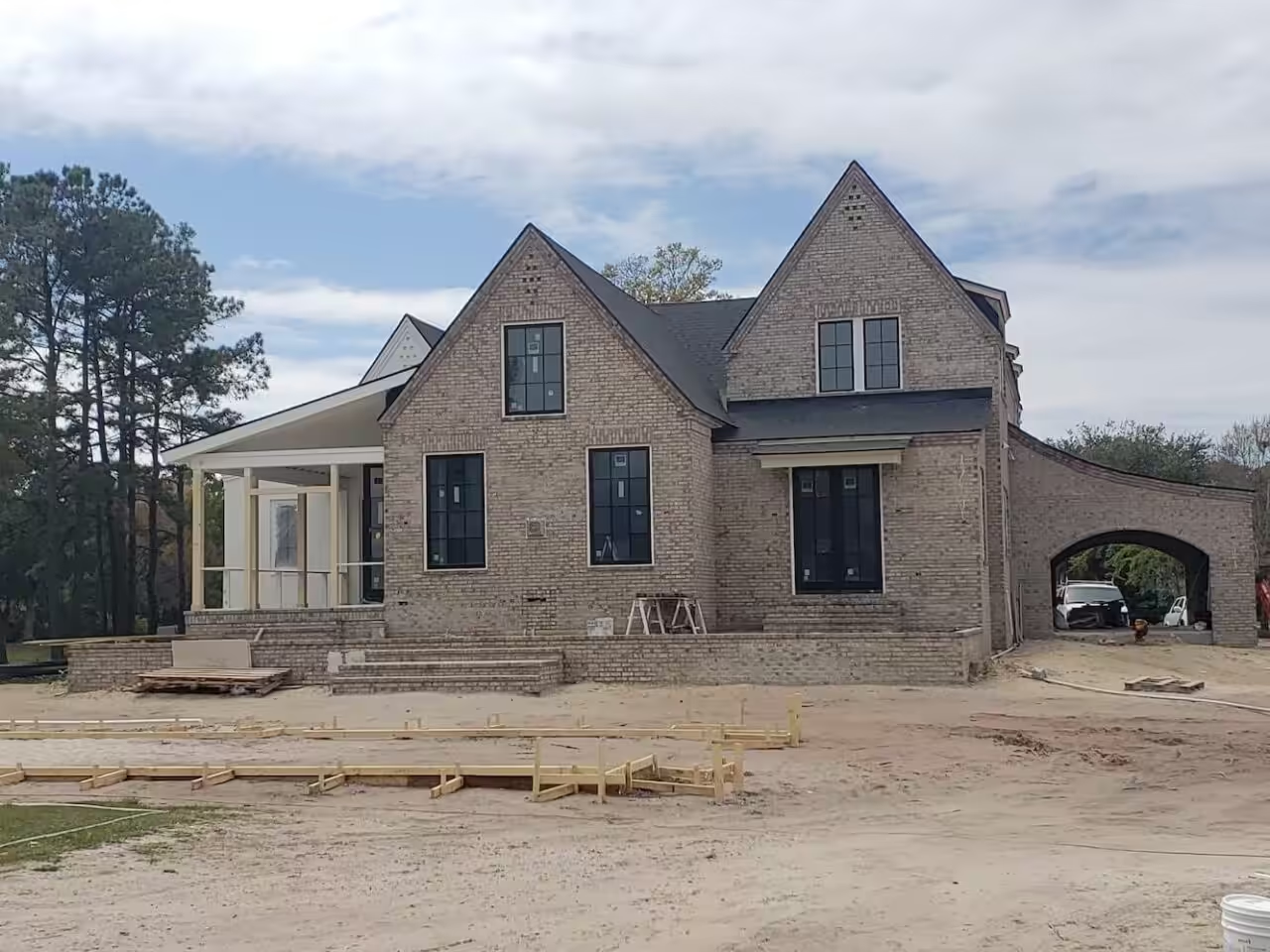

The change from warm tan brick to white is about as large as a color change gets. Coverage on that kind of change depends on the primer and on working paint into every joint, not only the brick faces.
Repainting brick that is already painted is a different job. Our commercial building on Eagle Drive is a two-story building in painted brick, and its project page records washing and surface preparation before the new coats.
Technical Note 6 adds that chalky old paint must be brushed or scrubbed off, and that alligatored paint has to be removed entirely before repainting.
Paint, limewash, stain or mineral paint
If the goal is a lighter or more even color rather than a solid painted finish, the BIA describes four alternatives:
- Limewash: lime putty, water and pigment; keeps the texture and breathability and weathers naturally.
- Mortar wash or German smear: a thin layer of mortar that lets parts of the brick show through.
- Brick stain: penetrates slightly, changes the color and leaves the texture visible.
- Mineral paint: bonds to the brick without forming a film, for when a painted look is wanted.
Each has its own prep and its own look over time, so ask to see a sample on your wall before deciding. For the color itself, test it against your roof, trim and light the way choosing exterior paint colors describes.
Decide as if it were permanent
The BIA calls removing paint from brick laborious and expensive, and in historic districts the BAR does not allow sandblasting at all for paint removal. In practice, a painted brick house stays a painted brick house.
So decide it the way you would decide on new siding: look at the whole house, not only the brick; check the water first; and make the call once.
If you have decided, or you want a second opinion on the wall in front of you, VMS Home Painting handles exterior painting in Charleston and nearby towns. Ask for a free estimate for your brick house, and tell us when the brick was laid and whether it has been painted before.