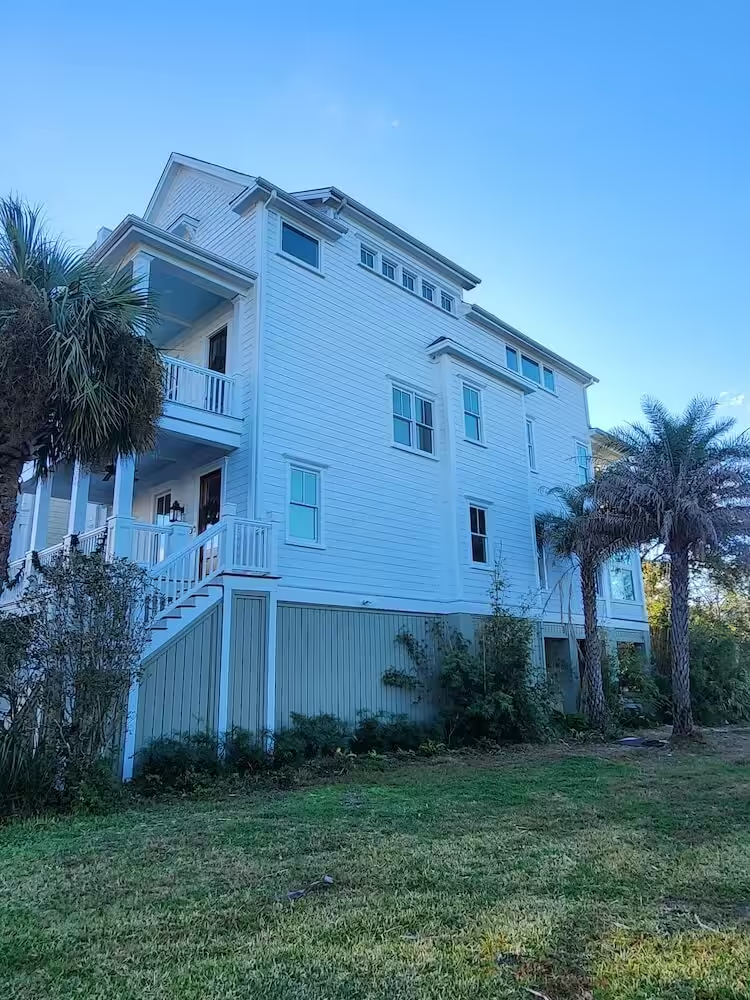
At Marines Cay on Folly Beach, the repaint did not happen all at once.
Two- and three-story condominium buildings in soft yellows, blues and grays, plus newer mid-rise buildings with glass balcony systems, were painted in phases, with the work coordinated with property management and the association’s requirements while owners kept living there.
That is the shape of most community repaints: many buildings, one color scheme, residents at home.
To plan an HOA repaint project, settle four things before you ask for a single bid: what the association is responsible for painting, how it will be paid for and approved, one written scope that every bidder prices, and a phasing plan residents can live with.
The nine steps below follow that order, with the decisions you will meet along the way and a checklist to print at the end.
Step 1: Confirm what the association paints
Start with the governing documents, not the buildings.
In a condominium created under South Carolina’s Horizontal Property Act, the bylaws must provide for the care and upkeep of the common elements (S.C. Code §27-31-160), and the exterior of the buildings is often one of them; the master deed and bylaws say which parts are common and which are limited to one unit.
In many communities of single-family homes it works the other way: each owner paints the house, and the association paints the clubhouse, gates, fences and signs. Your covenants decide.
Decision point: if owners paint their own homes, your project is a color program and an approval process, not a contract. Our guide to HOA paint color approval covers that side, from the owner’s point of view.
Step 2: Survey every building before anyone talks about color
Walk each building and list what will be painted: siding, trim, balconies, railings, stairs, doors, columns and common areas. Note the surface, the height and how it will be reached. Then list the repairs: soft wood, cracked stucco, failed caulk, rust.
The Painting Contractors Association’s maintenance standard (P8) says that corrective work by other trades should be completed before maintenance painting, so the carpentry and stucco repairs belong on the calendar ahead of the painters.
To sort spot repairs from a full repaint, building by building, use the decision tree in how often to repaint an exterior.
Step 3: Line up the money and the notices
A full repaint is one of the larger items most communities fund.
A reserve study is the usual planning tool: the Community Associations Institute’s reserve study standards describe a component inventory with useful and remaining life estimates, and a funding plan built on them. If your last study is old, the paint line is a good reason to update it.
Two South Carolina rules to know:
- Under the Homeowners Association Act, an association must give owners at least 48 hours’ notice before the meeting where it decides to raise the annual budget (§27-30-140). That section does not apply to associations incorporated under the state’s Nonprofit Corporation Act.
- In a condominium regime, co-owners share the costs of maintaining the common elements pro rata (§27-31-190), and the book of receipts and expenditures, maintenance and repair included, must be open to co-owners (§27-31-180).
Your call: reserves, a special assessment or a mix. How either is approved depends on your documents; ask your manager or the association’s attorney before the vote is scheduled.
Step 4: Write one scope that every bidder prices
Bids only compare when they answer the same document. For each building, the scope should name:
- every surface and element to be painted, and what stays unpainted;
- the repairs included, and how extra repairs found during prep will be priced;
- the level of surface preparation and the cleaning method;
- the coating system for each surface: primer where needed, product line, sheen and number of coats;
- colors by element, once they are approved;
- working hours, phasing and protection of landscaping, walkways and vehicles.
Spell out the small items. The PCA’s standard on typical exclusions (P23) lists things a painting contract does not include unless the documents name them: gutters and downspouts, roof-mounted items, fences and gates, light poles, benches, signage, mailboxes, planters and gazebos. In a community, those are exactly the pieces residents notice when they are skipped.
Step 5: Choose and approve the colors
Follow the approval path in your documents: an architectural committee, a board vote, or both. Summer House in Wild Dunes and South Hampton in Mount Pleasant, two of our published projects, each used one coordinated scheme across the complex; at South Hampton it ran through greens, yellows, grays and coral.
Before the vote is final, paint large samples on one real wall of each building type and look at them in morning and afternoon light. If any building sits in one of Charleston’s historic districts, the city’s Board of Architectural Review approval comes first.
Step 6: Collect bids you can compare
Send the same scope, the same site map and the same walk-through date to every bidder. Then ask each one for:
- the license number. In South Carolina, painting falls under the Nonstructural Renovation subclassification of the Contractor’s Licensing Board (§40-11-410), required once a job passes the amount set in §40-11-30; you can verify a license on the SC LLR website;
- a certificate of insurance naming the association;
- a schedule by building, with the crew size;
- the written warranty and what it covers; our article on what a painting warranty covers explains what to read for;
- references from other occupied communities.
Watch for: one bid far below the others. Check it line by line against the scope before anything else, starting with the prep and the number of coats.
Step 7: Phase the work around the people who live there
Our published condominium projects at Marines Cay, Summer House and the Daniel Island condominiums describe phased schedules built around resident activity. The Daniel Island page adds protection of landscaping and walkways, and ladders and access equipment for the upper elevations of a fully occupied community.
For your plan, that means three choices:
- the order of buildings: worst condition first, or the order that keeps parking and entrances usable;
- the season: Charleston’s humidity and the June-to-November hurricane season both shape the window, which we cover in the best time of year to paint outside;
- how much float to leave for rain days between phases.
Step 8: Tell residents what you need from them, building by building
Send each building its own notice, a week or more ahead of its start date. Include the dates, the working hours and the name of the person who answers questions.
Then list what residents must do: clear balconies and porches, move cars away from the walls being painted, keep windows closed on work days, bring in plants and decorations, and keep pets inside. A short reminder the day before the crew arrives helps residents who missed the first notice.
Step 9: Close out each phase, not just the project
The PCA’s close-out standard (P20) allows punch lists by phase and asks that they name specific items at specific locations, not general descriptions. For a community, that means walking each building with the contractor when it is finished, signing off on that list, and moving on.
At the end, keep a record in the association’s files: colors and codes by element, product lines and sheens, the date each building was finished, and the warranty. The next board will need it for touch-ups and for the next reserve study.
The board’s planning checklist
Print this and check items off at each meeting.
- Governing documents reviewed: what the association paints, what owners paint.
- Building-by-building survey done, with elements, heights and repairs.
- Repairs by other trades scheduled before painting.
- Reserve study reviewed or updated; funding decided.
- Owner notice given for any budget meeting (48 hours under §27-30-140, if it applies).
- One written scope: surfaces, prep, coating system, coats, colors, exclusions named.
- Colors approved, with samples seen on real walls.
- Bids collected on the same scope; licenses and insurance verified.
- Phasing plan and season chosen, with rain days built in.
- Resident notices drafted for each building.
- Punch list and sign-off for each phase.
- Final record filed: colors, products, dates, warranty.
What to send us when you are ready for a bid
If your board wants a bid from VMS Home Painting, send the community name, the number of buildings and stories, the elements in the scope, your color decisions so far and the season you are aiming for. If you have a survey or a reserve study page for the paint line, include it.
We repaint condo buildings and HOA communities across the Charleston area, and a walk-through comes first. Request a community painting bid to set one up.