A flake of paint that drops off your siding works a little like a core sample. Before you sweep it up, turn it over: the back usually says more about the problem than the front does.
Exterior paint peeling happens when the film loses its grip on the surface under it.
Most of the time the cause is water getting behind the paint, a surface that was dirty, chalky or glossy when it was painted, or paint that has grown old and brittle. The repair always runs in the same order: stop the cause, scrape back to paint that holds, prime what is bare, then repaint.
Painting over the peel only hides it for a while; Sherwin-Williams says plainly that it does not recommend painting over cracked or peeling paint.
First, turn the chip over
Pick up two or three flakes from the worst spot and look at the underside. You will usually see one of three things.
- Bare wood or siding on the back, with every coat attached. The whole paint system let go of the substrate. Sherwin-Williams’ problem solver reads it this way: when a failure goes all the way down to the surface that was painted, the likely cause is moisture escaping from that surface.
- Older paint on the back. The new coat let go of the coat under it. That points to preparation: the old paint was dirty, chalky or too glossy for the next coat to bond. The same guide’s fix is to scrape, sand glossy areas dull and let the surface dry before recoating.
- Many thick, brittle layers that snap rather than bend. Decades of coats have hardened until they can no longer move with the wood. Sherwin-Williams lists embrittlement with age, over-thinned paint and bare wood painted without primer among the causes of cracking that turns into flaking.
A related pattern is a web of small scales, like alligator skin, with old paint still showing between them. The paint maker connects it to a hard coating applied over a softer one, or to paint laid over a glossy finish.
Then look at where on the house it is peeling
The location narrows the cause further. Walk all four sides and note where the worst spots sit.
Porch ceilings, eaves and soffits
Sherwin-Williams treats peeling under eaves, porches and other protected areas as a failure of its own. Rain never reaches those surfaces, so nothing rinses them between paint jobs, and a coat brushed over that film has little to hold on to. Washing them is part of the prep, even when they look clean.
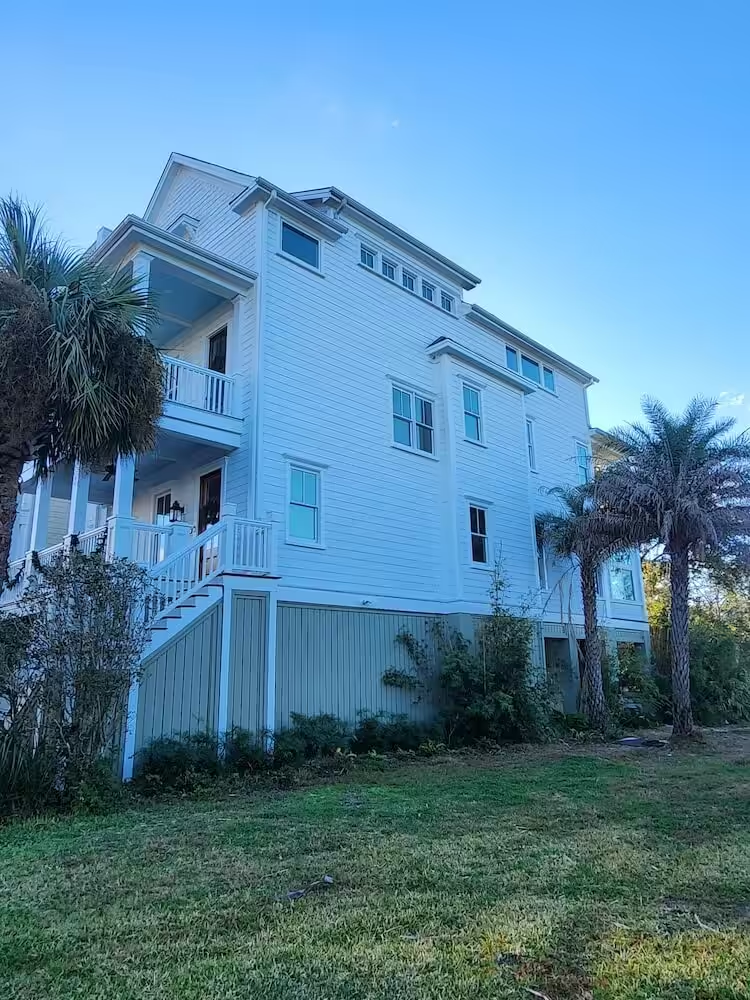
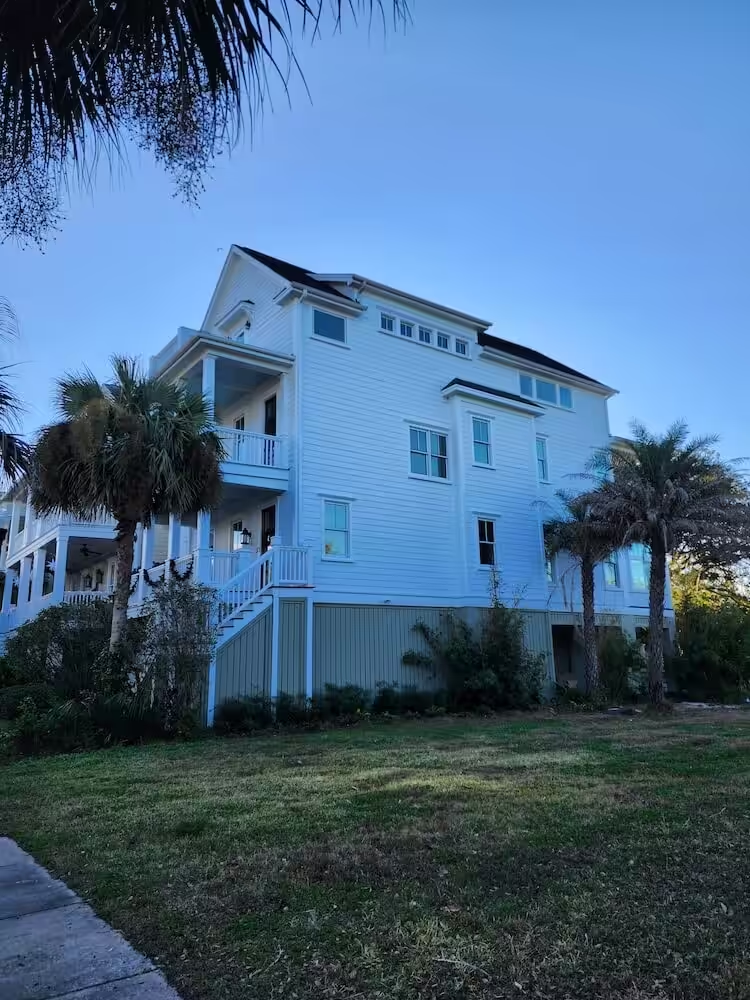
Lowcountry houses have a lot of this surface. Many of the coastal homes in our portfolio stand on raised foundations with porches stacked two or three high, like the Kiawah Island estate with wrap-around porches on three levels.
Every one of those levels has a ceiling and railings that the weather reaches only at the edges.
The bottom courses near the ground
Paint that fails along the lowest boards often has a simple cause: the siding sits too close to soil, mulch or a patio and stays wet. Sherwin-Williams’ guidance is that siding should be installed no less than 6 inches above the ground, and that wood touching the ground should be cut back.
Under gutters, roof edges and window trim
Streaks of peeling under a gutter or below a window corner point to water running behind the paint. The paint maker’s list of entry points includes worn or missing caulk at joints and openings, clogged gutters and roof leaks. Fix those first; new paint over a wet board will lift again.
Outside bathrooms, kitchens and laundry rooms
When the peeling sits on an outside wall that backs a shower, a range or a dryer, the water may be coming from inside. Sherwin-Williams describes interior moisture migrating through the wall and pushing the paint off from behind, and suggests vents, fans and dehumidifiers in those rooms.
The sunny side, soon after a paint job
Blisters that appear within days or weeks on the hottest wall can be heat blisters: paint applied in direct sun on a surface that was too warm.
Latex paint hit by dew, high humidity or rain shortly after it dried can blister too. If that happens on a recent job, read what your painter’s warranty says; our guide to what a painting warranty covers explains what is usually in and out.
A dark film that wipes or bleaches away is a different problem. That is usually growth on the paint, covered in our article on mildew on exterior paint.
How far the failure reaches
Test a ring of 6 to 12 inches around every peeled spot before deciding how much to scrape. That is the radius Sherwin-Williams gives for checking that the surrounding paint still adheres.
If the scraper keeps lifting paint as you move outward, the failure is wider than it looks, and spot repairs will keep chasing it.
Press a screwdriver into the wood where the paint is gone. Soft, punky wood means the board needs repair or replacement before any primer, which our guide to repairing rot before a repaint walks through.
Can you paint over peeling paint?
No. Loose paint has to come off first, down to edges that hold under the scraper.
Sanding the edges smooths the step between bare and painted areas, and bare wood gets an exterior primer before the topcoats. Primers sold for “peeling” surfaces help glue down the remaining edges after scraping, but no primer dries a wall that is still taking on water.
Older houses and the lead rule
Scraping and sanding old exterior paint is exactly the kind of work the EPA’s lead rules address. Under the Renovation, Repair and Painting Rule, anyone paid to disturb painted surfaces in a home built before 1978 must be certified and use lead-safe work practices.
The rule generally does not apply to owners working on their own home, but it does apply if you rent out all or part of it. If you do the work yourself on an older house, the EPA recommends lead-safe practices for do-it-yourselfers.
What sets the size of the repair
Two houses with the same peeling patch can need very different work. The scope, and the price with it, depends on:
- how much of each wall fails the scrape test, not just the visible flakes;
- the source of the water and whether it is fixed before painting;
- soft wood found once the paint is off;
- height and access: porch ceilings on a third level take scaffolding or a lift;
- the number of old layers and whether lead-safe practices apply;
- whether the repair is spot work or the start of a full repaint.
Walk-around sheet to print
Take this outside, one copy per side of the house. Fill it in on a dry day.
- Side of the house (street, back, left, right) and how much sun it gets.
- Where the peeling is: porch ceiling or eave, bottom boards, under a gutter or window, outside a bathroom or kitchen, open wall.
- Back of the chip: bare wood, older paint, or many brittle layers.
- Scrape test: does paint keep lifting within 6 to 12 inches of the spot?
- Wood under the bare spot: firm or soft.
- Water source nearby: gutter, caulk joint, roof edge, soil or mulch against the wall, a vent that blows on the wall.
- Year the house was built (before or after 1978).
- Photos: one close-up of the chip’s back, one wide shot showing where it sits.
Three things to do this week
Save a few chips in a plastic bag and photograph their backs next to the spot they came from. After the next heavy rain, walk the house and watch where water runs: gutters, downspouts, window corners, the base of the walls. And write down the year your house was built.
Those three notes turn a guess into a diagnosis, whoever does the repair. If you would like a second set of eyes, our exterior house painters in Charleston can walk the house with you; bring the sheet and schedule a free exterior estimate.