“Can you paint a whole house in a day?” The coats on a small, sound house, sometimes. The whole job, rarely: most exteriors need a wash day and at least one drying day before the first coat goes on.
The paint itself is the quick part: the data sheet for Sherwin-Williams’ Emerald exterior paint allows a second coat four hours after the first at 45°F and above, and calls for a single coat on most repaints.
So how long does it take to paint a house exterior? The coats take days; the whole job takes as long as the washing, drying, repairs, setup and weather around it.
As a planning number, a house that needs five working days of prep and painting should be booked for about 6½ working days in spring or fall and about 8½ in midsummer, by our estimate from NOAA rain data.
A light job goes faster: a review on our homepage describes two coats on a new home’s exterior in about a day and a half.
Below is each phase with the wait that a paint maker or a public agency prints for it, the decisions that add days, and a rough rain-day estimate for Charleston built from NOAA data.

The timeline at a glance
| Phase | What happens | Wait printed by the source | What stretches it |
|---|---|---|---|
| 1. Approvals | An HOA or the city signs off on the colors | None printed; each board works on its own calendar | A historic district or an association review |
| 2. Washing | Dirt, chalk and mildew come off the walls | Surface dry before paint; at least a day after a heavy soaking (Sherwin-Williams FAQ) | Wood, stucco or brick that soaks up water; cloudy, humid days |
| 3. Repairs and priming | Soft wood replaced, bare spots primed, gaps caulked | Caulk goes in after priming, with drying time before the finish (Emerald data sheet) | Rot that only shows once the walls are washed and scraped |
| 4. Setup | Ladders, scaffolding or a lift; plants, walks and cars covered; shutters taken down | None | Three stories, an elevated foundation, a tight downtown lot |
| 5. Coats | Body, trim, porches, doors and shutters | Recoat after 4 hours at 45°F and up, 24 to 48 hours at 35 to 45°F; no rain expected within 2 to 3 hours; surface at least 5°F above the dew point (Emerald data sheet) | Sun on the wall, dew in the morning, afternoon storms |
| 6. Walkthrough | Touch-ups and cleanup | None | Details that show up in full daylight |
The waits come from one product line. Other paints print their own numbers, so the data sheet for the paint on your estimate is the one that counts.
Step 1: Settle colors and approvals before you book
If someone else has to approve the color, their calendar comes first. Inside Charleston’s historic districts, the Board of Architectural Review’s general guidelines say there is no list of pre-approved colors and that a paint sample on the building may be required.
Our guide to how the Board of Architectural Review approves paint colors walks through that process.
Planned communities often have their own architectural committee. Get the approval in writing before a crew is scheduled, with the color names and codes for each part of the house.
No board and no association? Then this step is a short conversation about colors, and it adds no days.
Step 2: Wash, then let the house dry
Washing takes off the chalk, dirt and mildew that keep new paint from bonding. The Emerald data sheet is blunt about mildew: it has to be removed before painting, or it grows through the new coat.
Then comes the wait. Sherwin-Williams’ exterior FAQ notes that wood and masonry absorb more water from a soaking rain than aluminum or vinyl siding, and advises waiting at least one day after a heavy rain, with the surface dry before any paint goes on. A thorough wash soaks the same walls.
Siding material changes the wait: vinyl and aluminum dry faster; wood, stucco and brick after a cloudy week can need more than a day. Our article on pressure washing before painting covers how to tell when a wall is really dry.
Step 3: Repair what the washing uncovers
Clean walls show what dirt was hiding: soft sills, open joints, loose paint. Soft wood is replaced before priming, never painted over; the order is in our guide to wood rot repair before painting.
Primer and caulk set their own pace. The Emerald data sheet asks for caulk after priming, with drying time before the finish, and for two coats with four hours between them on bare surfaces, against one coat on a repaint.
One question changes this step more than any other: was the house built before 1978?
The EPA’s Renovation, Repair and Painting rule requires that anyone paid to disturb painted surfaces in those homes be a certified firm using lead-safe work practices. Containing the work area and cleaning it on scraping days adds setup and cleanup time to the schedule.
Step 4: Set up access and protect the property
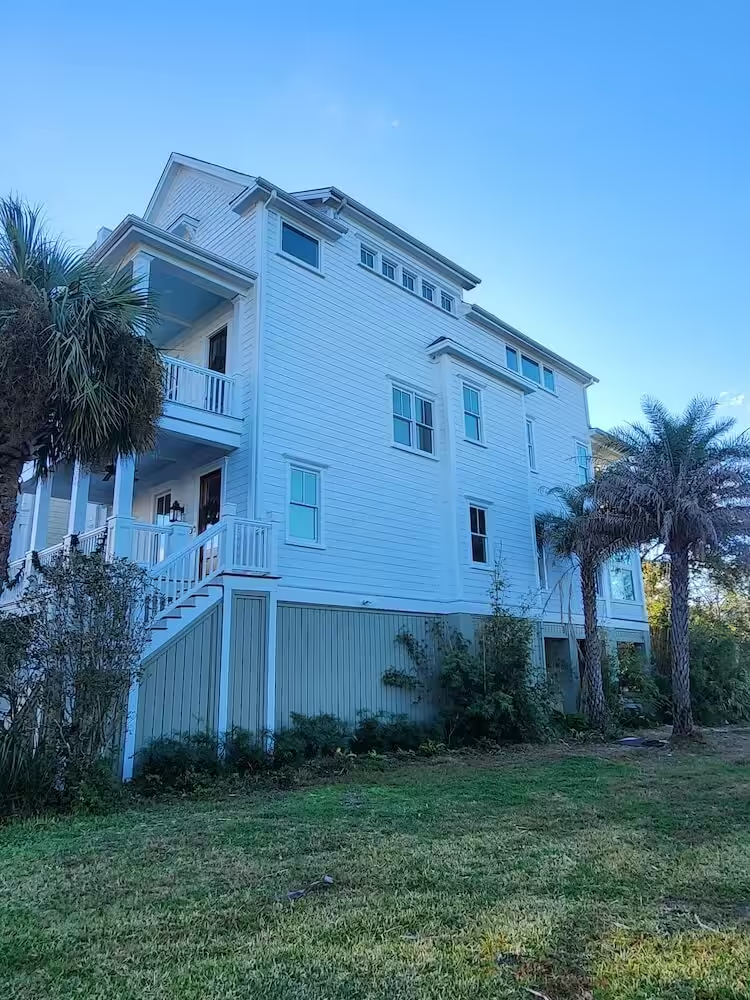
The photo at the top shows the street side of a Downtown Charleston townhouse we painted, in September 2019, before its vertical siding went charcoal. On a narrow lot with neighbors close on both sides, ladders go up one face at a time, and every move takes time.
A one-story ranch can be reached from ladders. An elevated beach house or a three-story home may need scaffolding or a lift on each side, which takes longer to set up and to move.
Protection belongs here too. In a review on our homepage, a homeowner noted that the crew took the shutters down to paint them and covered the neighbors’ cars while they worked. Both steps take minutes on the day and save hours of cleanup later.
Step 5: Coats, one side of the house at a time
A coat goes on in hours, but the daily window is narrower than the clock suggests. The paint maker’s rules set it:
- Do not paint in direct sun, and expect the paint to set up fast above 80°F (Emerald data sheet).
- Leave at least 4 hours of dry time before evening moisture settles on the surface, and stop earlier on cooler days (Sherwin-Williams FAQ).
- Skip the coat if rain is expected within 2 to 3 hours (Emerald data sheet), and keep the surface more than 5°F above the dew point, the industry rule Benjamin Moore’s temperature guide also states.
In practice, a crew starts on a wall once the morning dew has burned off, follows the shade around the house and stops with enough daylight left for the paint to set. That is why one side can fill a day even when the coat itself takes a few hours.
A strong color change can need an extra coat to look even. Ask that the estimate state the number of coats for the body and the trim.
Weather days: a rough estimate for Charleston
Rain is the variable nobody controls, so we ran a simple estimate with NOAA’s 1991–2020 climate normals for Charleston International Airport.
We counted a work day as lost if it rains a tenth of an inch or more, or if it is dry but follows a half-inch rain, following Sherwin-Williams’ advice to wait a day after a heavy rain.
Treating days as independent, so no day is counted twice, we divided five dry days by the share of days left.
| Month | Days with 0.10 in. of rain or more | Days with 0.50 in. or more | Working days to book for 5 dry ones (our estimate) |
|---|---|---|---|
| April | 5.4 | 2.1 | about 6½ |
| July | 9.4 | 4.4 | about 8½ |
| October | 4.6 | 2.3 | about 6½ |
| December | 5.7 | 2.3 | about 6½, with cold nights on top |
It is an average, not a forecast: rain clusters, and a dry week in July happens.
Still, it shows why a five-day job booked for midsummer is safer planned for eight or nine working days, which is close to two calendar weeks with weekends off. Month-by-month temperatures and the paint makers’ limits are in our guide to the best time of year to paint a house exterior.
What a short job looks like
The day-and-a-half job in that homepage review was a new home. New construction and recently painted houses usually skip most of steps 2 and 3: little to wash, little to repair, no lead-safe setup.
An older house with peeling paint and soft trim is the opposite. Most of its schedule goes into washing, drying, scraping and repairs, before the first coat of color goes on.
Quick answers
What happens if it rains two hours after painting?
The Emerald data sheet says not to apply the paint if rain is expected within 2 to 3 hours, so a storm that arrives sooner can mark the fresh coat.
The affected wall is checked once dry; what rain does to fresh paint, and what to do about it, is in our best-time guide linked above.
How long does exterior paint take to dry at 70 degrees?
For Emerald exterior at 45°F and up and 50% relative humidity: dry to the touch in 1 hour, ready for the next coat in 4. Higher humidity and thicker films take longer.
The scheduling mistake to avoid
Booking a start date before you know what the house needs is how a one-week job stretches out. If the colors still need a board’s approval, or nobody has looked closely at the sills and porch posts, the crew arrives to a schedule built on guesses.
Settle the approvals, have the house walked, and only then lock the dates. When you ask for an estimate, send a photo of each side of the house, the year it was built and the window you would like the work done in.
VMS Home Painting provides exterior painting for Charleston homes, from the peninsula to the islands. Request a free exterior painting estimate, and ask that it list the prep, the repairs and the number of coats behind the dates.