“How do I remove mildew from my exterior paint?” is one of the questions Google shows next to this topic. Before you answer it, answer a simpler one: is that gray, black or green film actually mildew?
Mildew on exterior paint is a fungus growing on the surface of the film, usually on shaded, damp walls.
Confirm it with a few drops of household bleach, wash it off with a bleach solution mixed the way the paint maker says, rinse, and let the wall dry. If the paint underneath is sound, you may not need to repaint at all. If it keeps coming back, the cause is shade and moisture, and that is what you fix.
The bleach-drop test comes first
Put a few drops of household bleach on the dark area and wait a few minutes. Sherwin-Williams and Florida Paints describe the same test: if the discoloration bleaches out, it is probably mildew; if it stays, it is probably dirt or some other contamination.
Do it on a small spot and rinse afterward. Bleach can lighten some colors, and Diamond Vogel recommends a test area to check for fading before you treat a whole wall.
Decision tree: what the dark film is, and what to do
Work down the branches in order. Most houses land on the first or second.
- If the spot bleaches out, it is mildew.
- Paint underneath is intact (no peeling, blisters or bare wood): wash, rinse, let dry, and stop there. Sherwin-Williams says that if mildew is the only problem, painting may not be necessary after cleaning.
- Paint underneath is failing: wash and dry first, then repair and repaint. Painting over it is the one thing to avoid; Sherwin-Williams’ exterior data sheets say mildew must be removed before painting or it will grow through the new coat.
- If the spot does not bleach out, it is not mildew.
- It wipes off on a damp cloth: dirt. Scrub with a mild detergent and rinse.
- A dry hand comes away coated in white or colored powder: chalk from weathered paint. Diamond Vogel notes chalk causes fading and rundown and can be removed by scrubbing or power washing before any new coat.
- Paint is lifting, cracking or bubbling: a paint or moisture failure, not a stain. Find the water source before repainting. Our guide to exterior paint peeling shows how to read a paint chip to find the cause.
- The wood under the stain feels soft when pressed: possible rot. Our guide to soft wood and rot repair covers what to probe and in what order.
Why it comes back on the same walls
Mildew needs moisture and something to feed on. Diamond Vogel’s maintenance bulletin says mildew is most likely to form on northern exposures and in shaded, damp areas, and that airborne dirt on paint can be a source of nutrients for it.
The Charleston climate supplies the moisture. In NOAA’s 1991–2020 hourly normals for Charleston International Airport, the 6 a.m. temperature from June through September sits only about 2.5 to 3 degrees above the dew point. Walls that cool overnight collect dew, and a wall the sun never reaches stays wet longest.
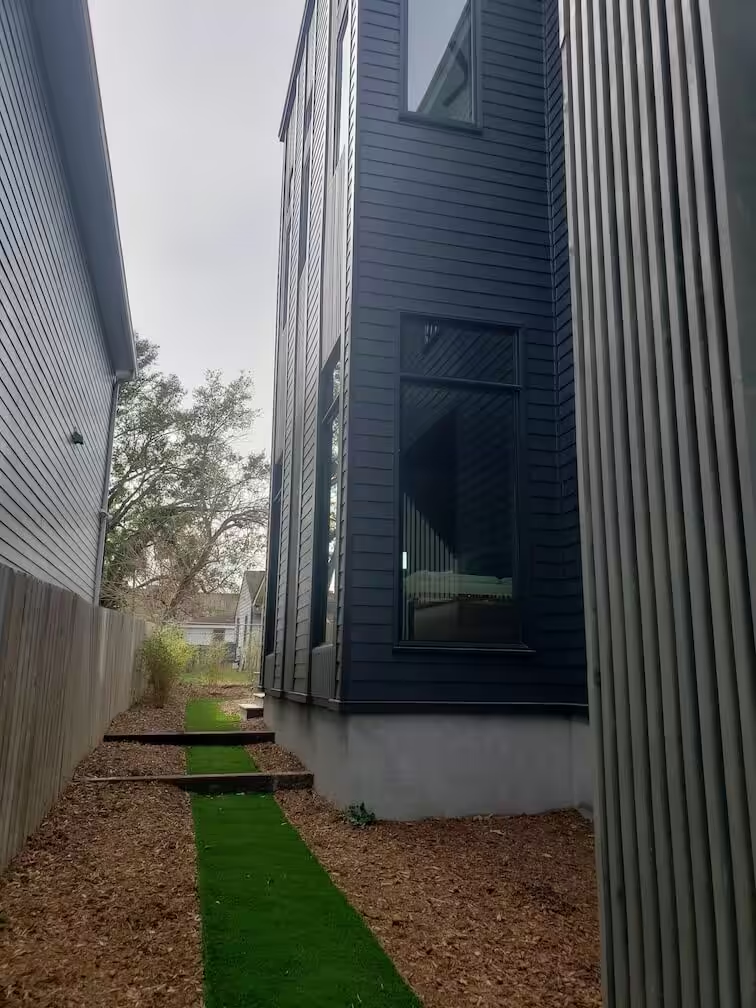
Narrow side yards like the one beside this Downtown Charleston townhouse we painted get only a slice of direct sun. Walls in spots like this, under deep porches and behind dense shrubs, are the first places to check each year.
Other water sources are easy to miss: sprinklers that hit the siding, a dripping air conditioner line, gutters that overflow. The EPA’s mold guidance puts it plainly: if you clean mold but don’t fix the water problem, the mold will most likely come back.
Three paint makers, three cleaning recipes
Paint makers agree on the method and disagree on the details. Here is what three of them publish:
| Source | Mix | Contact time | What they say not to add |
|---|---|---|---|
| Sherwin-Williams, mildew guidance for painters | 1 part liquid bleach to 3 parts water; scrub the area | 10 minutes, then rinse thoroughly | No detergents, no ammonia |
| Diamond Vogel, exterior maintenance bulletin | 3 parts water to 1 part household bleach, by brush or pump sprayer | 3 to 5 minutes, then rinse completely | No detergents, no ammonia |
| Florida Paints, mildew problem solver | 1 quart bleach, 3 quarts warm water and 1/4 cup ammonia-free dishwasher detergent, or a commercial mildew remover | Not stated; rinse surface and surroundings thoroughly | Never ammonia or cleaners that contain it |
The ratio is the same in all three.
The rule every one of them repeats is the one that matters most: never mix bleach with ammonia or ammonia-based cleaners. Florida Paints warns the vapors can be harmful or even lethal. Two of the three also say to leave detergent out entirely, so if you add soap, use only one labeled ammonia-free.
Is outdoor mildew dangerous to clean?
Treat it as something to keep off your skin and out of your lungs. The EPA says molds produce allergens and irritants, and that inhaling or touching mold or spores may cause allergic reactions in sensitive people, from sneezing and red eyes to skin rash. If you have health concerns, it recommends talking to a health professional before cleanup.
For the work itself, the EPA advises long gloves made from natural rubber, neoprene, nitrile, polyurethane or PVC when using bleach, and goggles without ventilation holes.
Where pressure washing fits
In all three recipes above, the solution does the cleaning and the rinse carries it away; pressure is not what removes mildew. High pressure brings its own risks to siding, caulk and soft wood. Our guide to pressure washing before painting covers pressure limits by siding type and how long to wait before paint.
A wash-day checklist to print
- Bleach-drop test done on each discolored area; dirt and chalk ruled out.
- Test patch checked for fading before treating the whole wall.
- Gloves (natural rubber, neoprene, nitrile, polyurethane or PVC) and unvented goggles on.
- Plants and shrubs wetted or covered; nearby windows closed.
- Bleach and water mixed per one maker’s instructions, with no ammonia and no ammonia-based cleaner in the bucket.
- Contact time kept within that maker’s range.
- Wall and surroundings rinsed thoroughly with clean water.
- Water sources checked: sprinkler heads, A/C drip line, gutters, downspouts.
- Wall left to dry fully; paint condition inspected before deciding on a repaint.
When the wall does need paint
If the paint under the mildew is peeling, chalking heavily or worn through to bare wood, a repaint is due. Clean first, let the wall dry completely, prime bare wood, then paint.
The product affects how soon the problem returns. Diamond Vogel’s bulletin says flat paints, oil-based paints and lower-cost paints are more susceptible to mildew growth, and that exterior paints in general can support mildew after a couple of years of weathering.
A quality exterior acrylic chosen with the shaded walls in mind, plus a washing routine of once or twice a year as the same bulletin suggests, keeps the problem small.
Next season, before it spreads
After the humid months, walk the north side and every shaded wall with the bleach test in mind. Small patches caught in fall are a bucket-and-brush job; a season of growth under a porch ceiling is a bigger one.
When the wash shows paint that is past saving, VMS Home Painting can plan the exterior repaint, from cleaning and repairs to the final coat. Book a free exterior estimate and point us to the walls where mildew keeps coming back.