Exterior paint lasts as long as its film keeps protecting the surface underneath, which is not the same as how long it looks fresh. A wall can look tired and still be sound, or look fine from the street while the paint on a window sill has already cracked and let water into the wood.
Painting company guides usually quote five to ten years for a repaint, but no trade standard sets a number, because four things move it: the surface, the prep, the exposure and the upkeep.
The Painting Contractors Association’s maintenance standard (P8) does not promise years at all. It puts the owner on a schedule of inspections once the painter’s warranty ends. Here is how each factor works, and a checklist for that inspection.
What “worn out” actually looks like
Paint ages from the top down.
In its glossary (Standard P9), the PCA describes erosion as the wearing away of the film by wind, dust and dirt, sped up when ultraviolet light breaks down the binder and the surface starts to chalk.
Diamond Vogel’s bulletin on maintaining exterior paint adds that chalky pigment released as paint weathers fades colors and leaves rundown on the wall below.
Chalk and fading are slow. The same bulletin lists the failures to repair right away:
- cracking or checking;
- blistering, peeling and loss of adhesion;
- serious fading and loss of gloss;
- signs of rust on metal.
Any of these on one part of the house is a repair, not necessarily a repaint. Paint “lasts” as long as you catch them early. To decide which walls need paint this year and which can wait, see our guide on how often to paint a house exterior in Charleston.
1. The surface underneath
The same can of paint lives different lives on different materials. What the product data sheets and the paint makers flag for each:
- Wood moves with moisture, and its weak points are end grain, sills and joints. Cedar, redwood and knots can bleed tannin through a new coat, which is why Sherwin-Williams’ exterior data sheets call for a spot primer where staining persists. Soft or rotted wood under the paint ends its life early; see wood rot repair before painting.
- Stucco and masonry need curing before paint. Sherwin-Williams’ Emerald exterior data sheet asks for 30 days on new stucco, or 7 days plus a masonry primer, and a high-pH-resistant primer where the pH is above 9.
- Vinyl has a color limit rather than a time limit: the same data sheet says not to go darker than the original color, or below a light reflectance value of 56, unless you use the maker’s vinyl-safe colors.
- On metal railings and doors, rust is the failure to watch, and Diamond Vogel puts it on its repair-now list.
2. The prep the job got
Prep decides more than the paint brand. Sherwin-Williams writes it into its data sheets: any surface preparation short of total removal of the old coating may compromise the service length of the system. Few houses need total removal, so the real question is how far short of it the job stopped.
The PCA’s Standard P14 gives that a name.
It describes four levels of preparation for repaint work, from Level 1 (basic cleaning, with no assurance that old coats are well bonded) to Level 4 (filling and sanding until defects deeper than 1/32 inch are gone).
Level 2, the one that examines existing coatings for adhesion and treats longevity as the main concern, is what a contract implies when it names no level.
Ask which level an estimate includes, and for which parts of the house. A warranty is not the same thing as a lifespan either; our guide to what a painting warranty covers explains the difference.
3. The exposure your walls get
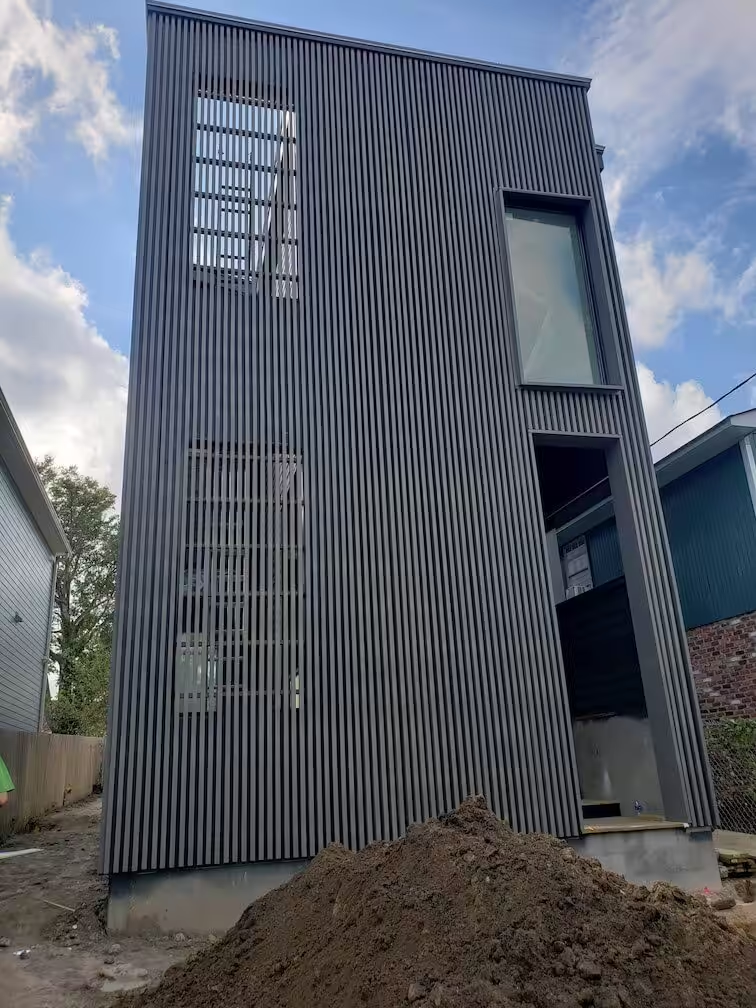
Every exterior paint job starts its clock on a day like this one: a downtown Charleston townhouse we painted in charcoal, photographed while construction was still going on. From then on, two things wear it down here: water and sun.
Water first.
We ran NOAA’s 1991–2020 hourly climate normals for Charleston International Airport through the standard Magnus humidity formula.
On an average-year basis, the air sits at 80 percent relative humidity or higher for about 3,300 hours a year, close to 38 percent of all hours. Treat that as an approximation: normals are averages, and real years swing above and below them.
From August through October, it is more than half of all hours. Eighty percent above freezing is the “time of wetness” threshold used in ISO 9223, the international standard on atmospheric corrosion.
That moisture is what feeds mildew. Diamond Vogel notes that mildew is most likely on northern exposures and shaded, damp areas, and that flat, oil-based and lower-cost paints are more susceptible. Our guide to mildew on exterior paint covers how to tell it from dirt.
Then sun.
West-facing walls take the hot afternoon light, and dark colors absorb the most heat: Benjamin Moore notes that a black wall in direct sun for a few hours is likely to be substantially hotter than the air. Expect the south and west sides of a house to chalk and fade first, and the north side to grow mildew first.
4. The upkeep it gets
Diamond Vogel suggests washing painted exteriors once or twice a year to remove dirt and chalk, and monitoring the paint to catch failures early, so later repairs cost less.
On who does what, the PCA’s P8 is more specific.
During the warranty period, the painting contractor repairs defects in its material or application. After that, periodic inspections are the owner’s responsibility.
Corrective action can extend to the causes underneath: moisture getting in, damaged or missing caulk, an aggressive environment, a moving substrate or a settling structure. Its warning is blunt: neglecting maintenance can end in removing and replacing the substrate itself.
If you are still choosing products, our checklist for the best exterior paint for a humid climate covers what to look for on the label.
A yearly walk-around checklist to print
Do it once a year, ideally after the humid months, with the checklist on a clipboard and a phone for photos. Note the date and the side of the house for each finding.
- South and west walls: rub a clean dark cloth on the paint. Heavy white chalk on the cloth means the film is eroding (the PCA’s prep standard cites ASTM D4214 as the method for rating chalk).
- North walls and anything shaded: look for dark speckling that does not wipe off with water; follow the bleach-drop test in our mildew guide.
- Window sills, door bottoms, trim joints: look for hairline cracks and press the wood with a fingertip; soft wood goes on the repair list.
- Caulk at windows, doors and trim: cracked, shrunken or missing caulk is one of the causes P8 names.
- The bottom two feet of every wall: rain splash, sprinklers and soil keep this band wet.
- Porch ceilings, columns and railings: blisters and peeling under cover usually mean moisture from behind or above.
- Metal railings, gates and hardware: any rust spot gets cleaned and primed before it spreads.
- Gloss: compare a protected spot, such as under an eave, with an exposed wall. A big difference in sheen is wear you can see.
When the findings on one side add up to more than scattered spots, ask for a price to repaint that side next to the price for repairs. The PCA’s spot-repair standard (P24) notes that patched areas usually stay visible, and that both the repair and the old finish keep aging differently.
Write down what went on the walls
The only way to know how long your own exterior lasts is to know when it was painted and with what.
When a job ends, keep a one-page record: the date, the product line for the body and the trim, each color’s name and code, the sheen, the prep level and who did the work. Tape a copy inside the garage door next to the leftover cans.
That page turns the next inspection, the next touch-up and the next estimate into facts instead of guesses. If your walk-around turns up more than spot repairs, VMS Home Painting provides exterior painting across the Charleston area; ask for a free exterior estimate and bring your notes.