A haint blue porch ceiling is a pale blue or blue-green ceiling, a Lowcountry custom rooted in Gullah tradition, where the blue was meant to keep “haints,” or spirits, away from the house. Most people who paint one today also want the look: a covered porch that stays light and feels open to the sky.
The claim you will hear most often is that the color also keeps wasps and spiders away. When NPR looked into it in 2006, Nathan Erwin, director of the Smithsonian’s O. Orkin Insect Zoo, said he and his colleagues had found no scientific research on the subject.
Five common beliefs about haint blue, checked
“Haint blue is one specific paint color.”
It is a family of shades, not a single formula. Every major paint brand sells several pale blues and blue-greens under the idea. Some lean toward sky blue, some toward sea glass green. The table further down compares six of them with the manufacturers’ own numbers.
“It started as a decorating trend.”
It started as a belief. In NPR’s report, Alphonso Brown, a guide with Gullah Tours in Charleston, explained that a haint is a spirit or a ghost, and that many people in Charleston also paint the trim of their houses blue to ward off evil spirits.
The blue has deep roots in the region’s history too. The South Carolina Encyclopedia records indigo, the source of blue dye, as a colonial cash crop reintroduced in the 1740s and tended by enslaved people, with exports to England peaking in 1775.
“It’s a Charleston thing.”
Charleston is part of it, but the culture behind it runs along the whole coast. Congress designated the Gullah Geechee Cultural Heritage Corridor on October 12, 2006, and the National Park Service describes it as running from Pender County, North Carolina, to St. Johns County, Florida.
Blue porch ceilings now show up well beyond that coast, but this is the region the custom is tied to.
“The blue keeps bugs and birds from nesting.”
Unproven. The Smithsonian answer in NPR’s report is the closest thing to an expert check, and it found no research either way. Erwin called it an interesting study for a student to take on. Until someone does, don’t count on a blue ceiling for pest control.
“Any light blue will look the same up there.”
Not usually. A porch ceiling sits in the shade of the roof, so a chip that looks pale in your hand can look deeper overhead. That is why the number worth comparing is light reflectance value, not the name on the card.
Six haint blue shades compared by light reflectance value
Light reflectance value (LRV) measures how much light a color bounces back, on a scale where black is close to 0 and white close to 100. On a shaded ceiling, a higher LRV keeps the porch brighter.
Each number below comes from the manufacturer’s own published color data, and each swatch uses the manufacturer’s hex value, so treat it as a guide: screens shift color.
| Swatch | Color | Brand and number | LRV | Leans toward |
|---|---|---|---|---|
| Glimmer | Sherwin-Williams SW 6476 | 78.4 | Very pale green-blue, almost white | |
| Waterscape | Sherwin-Williams SW 6470 | 61.5 | Green, sea glass | |
| Tradewind | Sherwin-Williams SW 6218 | 60.7 | Soft gray-blue | |
| Woodlawn Blue | Benjamin Moore HC-147 | 60.7 | Blue-green | |
| Palladian Blue | Benjamin Moore HC-144 | 60.4 | Blue-green | |
| Upward | Sherwin-Williams SW 6239 | 57.4 | Gray-blue, closer to sky |
The “leans toward” column is our reading of each color’s hex value, so check it against a real sample. Most of the list sits around 57 to 62, which keeps a covered porch light without looking white. Glimmer, near 78, suits a deep porch where you want the color barely there.
How to test before you commit:
- Paint two or three large samples on the ceiling itself, not on the wall, and look at them for a few days.
- Check them at midday and again at dusk, when the porch is actually used.
- Hold each one next to the house’s trim white and the floor color. Choosing the whole exterior palette at once is covered in how to choose exterior paint colors.
Not every Lowcountry porch ceiling is blue
Haint blue is one option, and the porch ceilings in our own project photos show two others. None of the porches published in our portfolio has a blue ceiling, so we’re showing what we have painted rather than borrowing someone else’s photo.
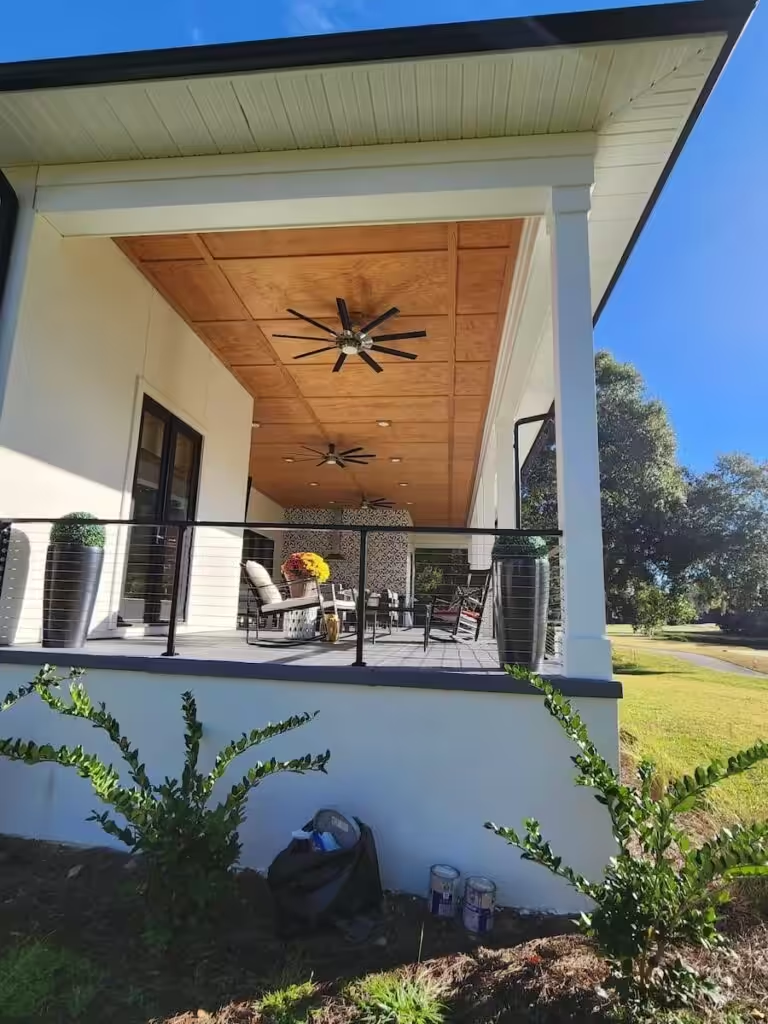
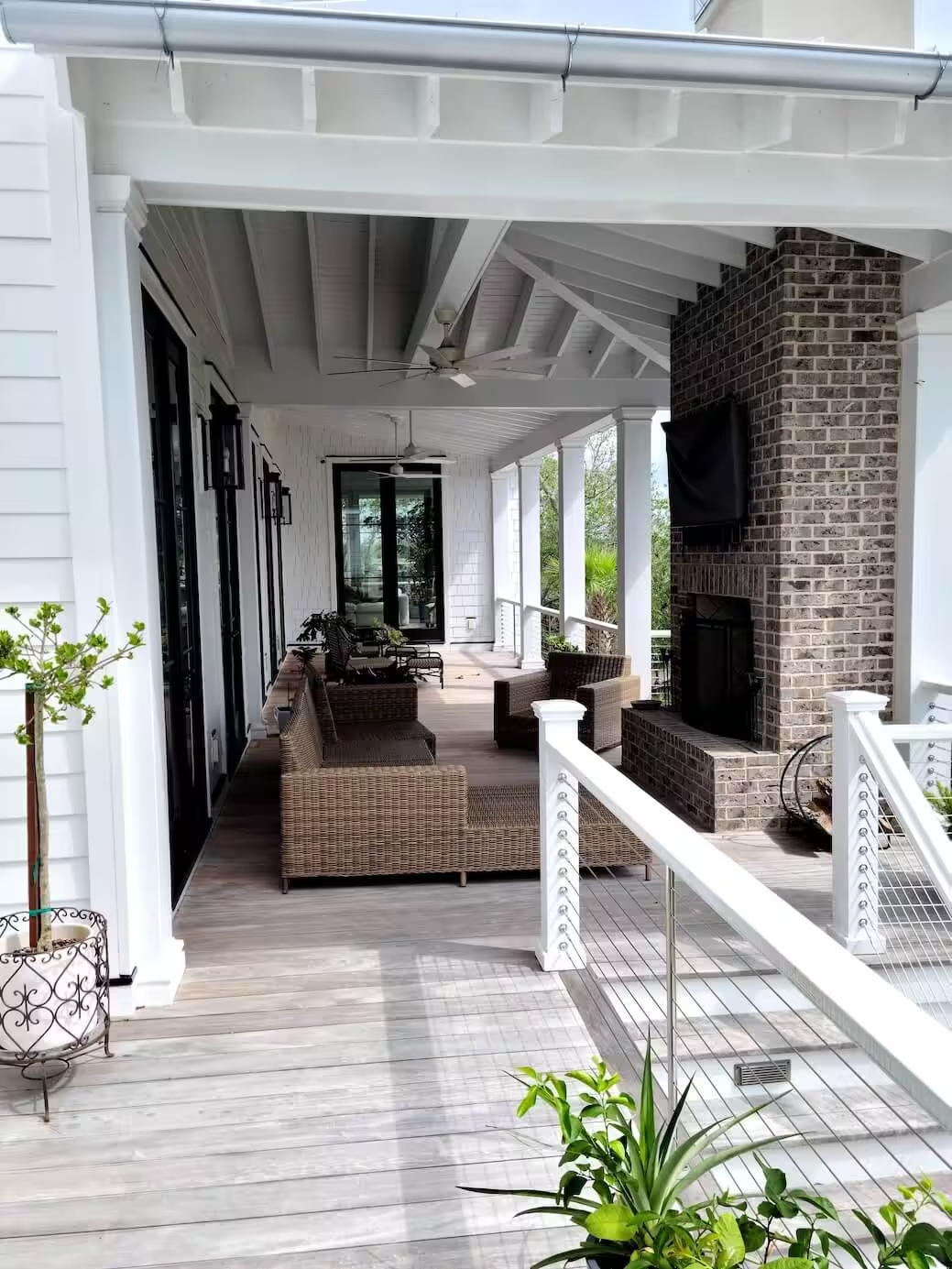
At this Coosaw Creek home in North Charleston, the covered outdoor area kept a natural wood plank ceiling, stained and finished against a white exterior. On the Island Park estate in Mount Pleasant, the photo at the top of this page, the porch ceiling and rafters are white.
White keeps the porch brightest and matches the trim. Stained wood brings warmth but needs its finish renewed on its own schedule. Haint blue sits between the two and adds the one thing neither does: a little color overhead.
Painting a porch ceiling so it lasts in the Lowcountry
A porch ceiling never gets rained on directly, yet it fails in its own ways, because shade and damp air work on it all year. Whether it is a one-day job or part of a Charleston exterior repaint, three checks come before the color.
- Clean off mildew first. Porch ceilings stay shaded and damp, which is where mildew settles. How to tell it from dirt, and how to wash it, is in mildew on exterior paint.
- Find out why old paint is peeling. Blisters and peeling under a roof usually point to moisture from above or behind, and a new color won’t fix that. See exterior paint peeling for how to read the chip.
- Use an exterior product rated for the surface. What to look for on the label in a humid climate is in our guide to the best exterior paint for a humid climate.
What goes into the price of a porch ceiling
We don’t publish prices, since they change. A porch ceiling estimate depends on:
- The square footage and the ceiling type: flat panels, beadboard or exposed rafters, which take far more brushwork.
- How much washing, scraping and spot priming the old finish needs.
- Whether the ceiling is painted or stained wood, and whether it’s changing from one to the other.
- Height, fans and light fixtures to work around, and whether trim, columns and railings are painted in the same visit.
If you’re weighing haint blue against white or stained wood, bring your shortlist of colors to the estimate. Ask for a free estimate for exterior house painting in Charleston, porch included.
Sources: NPR, “Why So Blue? Color Graces Many a Porch Ceiling,” All Things Considered, August 14, 2006 (Nathan Erwin, Smithsonian O. Orkin Insect Zoo; Alphonso Brown, Gullah Tours); National Park Service, Gullah Geechee Cultural Heritage Corridor; South Carolina Encyclopedia, “Indigo”; Sherwin-Williams and Benjamin Moore published color data.